

What is a turbocharger?
The Role and Function of the Turbocharger in the Engine
In the continuous development of internal combustion engines, one of the greatest challenges has been to simultaneously increase performance and efficiency. The turbocharger has provided one of the most successful solutions to this problem, utilizing the energy of exhaust gases to significantly boost engine performance.
What is a Turbocharger and Where Did it Originate?
A turbocharger is an auxiliary device for internal combustion engines that increases engine performance and efficiency compared to traditional naturally aspirated engines by compressing the intake air. The inventor of the turbocharger was the Swiss Alfred Büchi, who patented the principle of constant-pressure charging in 1905. The first road application occurred in the 1930s when Adolph Saurer AG began using the technology in diesel trucks.
The Operating Principle of Turbocharging
The operating principle of a turbocharger is based on utilizing the energy of the engine's exhaust gases through a turbine and a compressor to increase the amount of air flowing into the cylinder. This allows for more fuel to be burned, and the piston's intake stroke is also reduced.
Turbocharger Construction
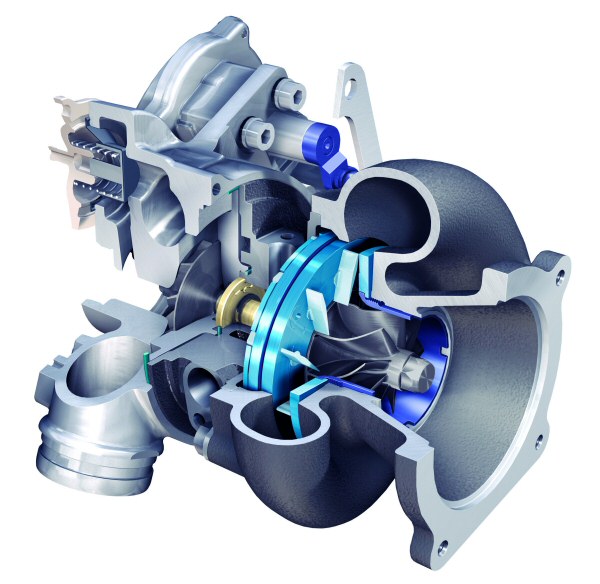
The main parts of the unit are the exhaust gas turbine and the compressor, which are located on a common shaft. Hot exhaust gases flow radially through the turbine, causing the turbine blades and shaft to rotate. The compressor, connected to the turbine shaft and typically of radial design, draws in fresh air and compresses it into the engine cylinders. The charging is practically self-regulating: when the throttle is applied, the energy of the exhaust gases increases, thus increasing exhaust pressure and consequently the amount of fresh air drawn in, allowing more fuel to be burned.
Types of Turbochargers
There are several types of turbochargers. In a conventional design, the exhaust gases from all cylinders are directed to a single turbocharger through a common manifold. In pulse charging, separate exhaust channels are used for better energy utilization. Twin-scroll turbochargers have a turbine housing divided into two parallel flow channels. Biturbo systems use two parallel-operating turbochargers, while sequential charging involves two turbochargers of different sizes operating alternately.
Technological Solutions
Modern turbochargers incorporate numerous advancements. The wastegate (bypass valve) allows a portion of the exhaust gases to be diverted from the turbine, thereby regulating the boost pressure. The variable geometry turbine (VGT) uses adjustable vanes to optimize airflow under different operating conditions. Intercooling plays a crucial role, as compression can increase air temperature by up to 180°C. Modern turbochargers can operate at speeds of up to 400,000 rpm, requiring special bearing and cooling solutions.
Advantages, Significance, and Maintenance
Turbocharger technology offers significant advantages: it increases the specific power output of engines, improves efficiency, and allows for engine downsizing while maintaining the same performance. The technology is continuously evolving and plays a key role in the development of modern engines, particularly concerning environmental regulations and efficiency requirements. However, it is important to note that a turbocharger is an extremely precise component, capable of operating at speeds up to 400,000 rpm, making it particularly sensitive to the overall condition of the engine. Engine wear, degradation of oil quality, or improper maintenance can lead to turbocharger failure, making regular servicing and adherence to manufacturer specifications crucial.
Search for turbochargers by turbo part number:
<